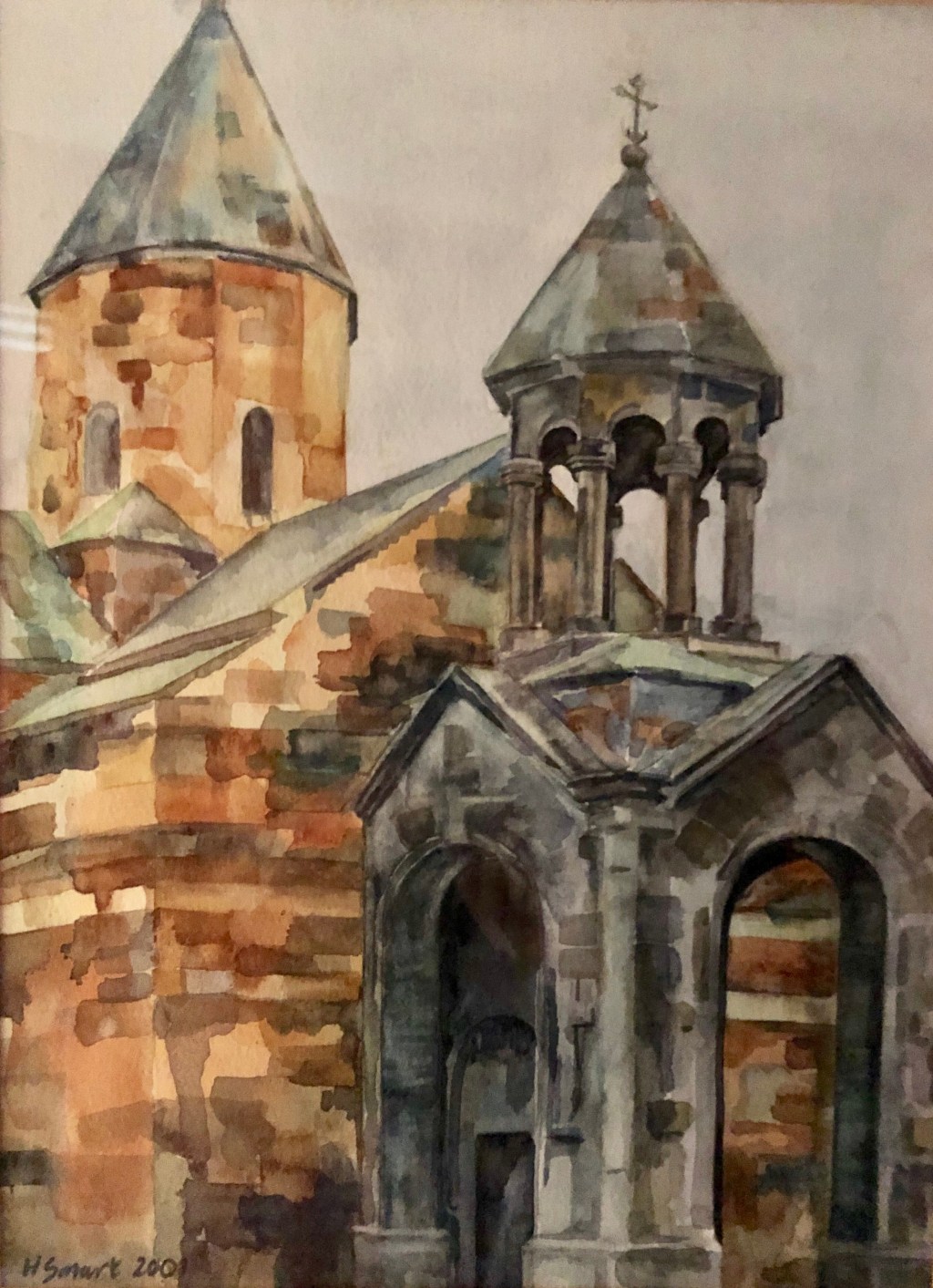
Painting of the month for December/January, reviewed by Patrick McConnell.
Painting of the Month: December 2019-January 2020
Armenian Church, Khor Virab
This evocative portrayal is of an ancient church in Armenia, located in the Plain of Ararat, close to the troubled borderline with neighbouring Turkey. This church was built upon the foundations of the sixth century churches on the site of the imprisonment of Gregory the Illuminator. Gregory is regarded as the founder of Christianity in Armenia, becoming the first country in in AD 301 to officially adopt the religion. The son of a nobleman who assassinated King Khosrov II and related to the Armenian king Tiridates, Gregory had earlier fled to Cappadocia. Influenced by early Christian beliefs, he returned to Armenia and attempted to persuade its rulers to adopt Christianity as the principal religion of the country. Gregory was imprisoned by Tiridates III, who was a Pagan, for 15 years in a dungeon in Khor Virab.
Khor Virap is now an Armenian monastery, located about 19 miles outside Yerevan. Situated on the Arafat plain, in the distance can be discerned the dramatic backdrop of Mount Ararat: this massive eminence is one with powerful symbolism for Armenians. A church was initially built on the site in 642 AD and rebuilt over the coming centuries; it has since become a place of pilgrimage. Armenia was eventually to grow into an impressive empire by 10th century, with its clashes with the acquisitive Romans documented by Roman historians.
There is a highly distinctive architectural style to the construction and layout of Armenian churches, that the eye is at once drawn to them and one soon appreciates that one is in the presence of something different. There is often to be found an octagonal tower and smaller cupolas and an additional archway acting as the guard to the church, as in this picture. The soft sandstone colours, grey green slates and virdigris tiles, weathered by time and history on the Ararat plain.
Helen’s painting captures elements of this tortured history, with the darker shadows and lighter aspects of the subject symbolic of Armenia and its long-suffering people. There are echoes of the efforts of those artists who have sought to depict churches. Consider the sheer range of treatments of churches in the history of art and contrasting approaches. Some are religious treatments; all are diverse treatments by artists but sharing the commonality of a place of worship. Constable comes to mind but his works often represent grand landscapes, where the churches functions in a secondary capacity, as a prop for the majesty of the countryside. Rather the more focused, smaller treatment of religious places are of relevance, such as the depictions of Dutch artists of churches, including the Grote Kerke, St Bavo’s, in Haarlem by Pieter Saenredam. Perhaps the most noteworthy comparison is with McIntosh Patrick’s Stobo Kirk, a realist portrayal of the 12th century church located in the countryside in the Scottish Borders This is dedicated to St Mungo, who shares some interesting commonalities with St Gregory. Intriguing comparisons in fact can be made between Scotland and Armenia. Both countries have been struggling with a search for independence and with their challenging histories; it remains to be seen if both still have it within themselves to forge new nations and different futures for themselves.
The visit, from which this painting received its inspiration, was undertaken on a December day, close to Christmas, which added an extra poignancy to the visit. The sky that day was leaden coloured, so very different from the scorching days of summer under skies of parched blue, experienced during a visit in the summer of the previous year, when temperatures upon some days would rise into the early 40s centigrade. The suffocating heat of the city of Yerevan could be replenished by the cooler, sweeter air of the mountains, where freshening breeze brought a welcome relief. The baking summer was mediated by the legendary hospitality of the Armenians. On our working visit we were well looked after, and guided through the complex cultural and historic legacies that have produced modern-day Armenia. During this summer we were told about the blockade imposed by the Turkish authorities led to shortages of water, as if life in the wake of the collapse of the former way of life associated with the USSR was already not harsh enough.
This hardship was largely ignored by the West, which had earlier failed to respond to the shocking genocide of Armenians in Eastern Anatolia by Turkish authorities in 1915. This lack of interest surfaced again during the 1990s and 2000s, reflected in Western disdain of Soviet achievements and the ushering in of cowboy capitalism. This was facilitated throughout the countries of the Former Soviet Union by the catastrophically inept advice of Western financiers and advisors, the ‘Marriotski’, who jetted in to urge privatisation, liberalisation and deregulation of the economy. Combined with corruption, patronage and resurgence of old scores to settle, along with a pointless and costly conflict with Azerbaijan over Nagorno-Karabagh, this disastrous mixture led to a fresh diaspora to other countries of young people.
Some determined non-governmental organisations and their staff have attempted to make a difference and improve the lot of people with mental health problems, including those affected by the traumatic earthquake of 1988 and other poor souls seeking a light in the dark times brought in by cataclysmic economic, social and political changes. Recently people have taken to the streets of Yerevan to demand reforms, leading to a change of government. The West could start to redeem itself, for its failures of 1915 and after the fall of the USSR, by enabling investment in education, health, governance and socially and environmentally responsible business, which can help to release the talents and energy of this country and its people.
As you travel around countries such as Armenia, Azerbaijan and Turkey, you may well be struck by the perception that they have much more in common than is appreciated. It is to be fervently hoped that these peoples and countries can learn to live together peaceably in the near future. Should you have occasion to pass by or visit an Armenian church, you may wish to take a moment to ponder upon the fates and future of their creators. Some churches have been demolished in Turkey and it is clear that these historically rich spaces need better protecting and cherishing for what they represent about the past and what they might have to say about the present.
Patrick McConnell, December 2019







 Art by Smart
Leave a comment